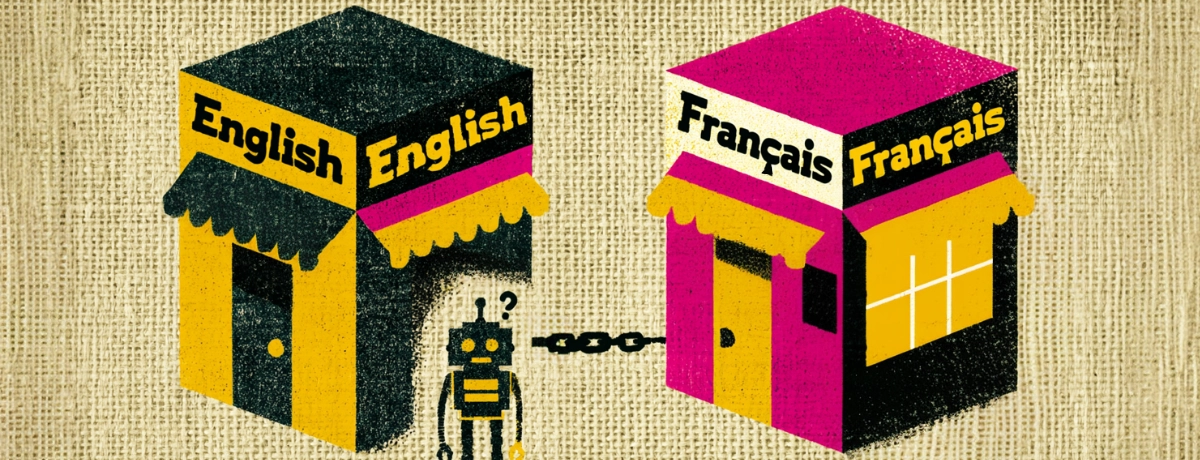
If your English and French sites aren’t explicitly connected to your official business records, AI engines can’t verify you exist.
What this article covers
The bilingual entity gap
If you manage digital properties in Canada, you are likely dealing with a search visibility problem that American SEO blogs aren’t covering: the bilingual entity gap. When a brand splits its content across English and French, AI search engines don’t automatically treat them as one business. Without explicit data mapping, they often read the two language versions as separate, unrelated entities, weakening authority in both.
AI engines don’t just read pages. They trace connections. Before citing a brand in an overview or shortlisting it for a user, an engine follows a chain of trust: checking whether the website, the business registry, and the language versions all point to the same verified entity. For Canadian agencies, building that chain doesn’t require complex code. It starts with the accessible, structured web layouts many are already building for compliance and goes one step further by connecting those assets to official Canadian data registries.
What you’ve already built
Agencies designing for Canadian digital accessibility standards are already doing the foundational work for AI. The clean semantic HTML, clear headings, and logical layout hierarchies required for accessibility compliance are the same signposts AI crawlers use to parse facts. If your site structure works for a screen reader, its core layout is already readable by an LLM.
Where the chain breaks
A clean layout helps an AI understand your text. It doesn’t prove your business is trustworthy.
AI models are built to avoid recommending unverified sources. To protect their outputs, they cross-reference what you claim on your website against external, authoritative databases. A May 2026 Ahrefs study of 6 million URLs found that pages cited by AI platforms are nearly three times more likely to carry structured organisational data than non-cited pages. But when researchers tracked 1,885 sites that added schema markup without backing it up with real-world authority, they saw no meaningful increase in AI citations.
The finding is precise: technical markup doesn’t create authority. It reflects it. If your English site, your French site, and your business filings exist as separate, unconnected records with no common thread, the chain of trust breaks and the engine cites someone else.
Take the common Canadian tracking problem: Most bilingual sites confuse AI engines by using different names across languages (like The Creative Studio in English and Le Studio Créatif in French) without telling the machine they are the same thing. If the engine can’t connect the localized names to a single master profile, your authority splits in half.
Closing the loop
Connecting your assets doesn’t require deep technical skills. It requires consistency across three areas.
- Map your name variations. Use your exact legal name across all records. If you use different operating names in English and French, use hidden website data (Schema markup) to explicitly list them as “alternate names” tied to the same business.
- Provide a universal business ID. Don’t just link to a registry webpage; URLs change. Add your official 9-digit Canada Revenue Agency (CRA) Business Number or provincial ID directly into your site’s metadata. AI engines use these unique numbers as master keys to verify your business without guessing.
- Nest your translations in one graph. Instead of treating your English and French homepages as separate profiles that link to each other, use a unified data block (
@graphschema) that tells the engine: “This is one single organization that happens to speak two languages.”
The Canadian advantage
Canadian agencies operate in a bilingual, compliance-driven environment by necessity. That pressure produces something valuable: clean structure, clear hierarchies, and documented entity relationships that most single-language competitors never build. Addressing these regional requirements rather than working around them produces a connected digital footprint that holds up under AI verification.